Dropbox DocSend
Advanced Data Room
Soft Launch
The Problem Space
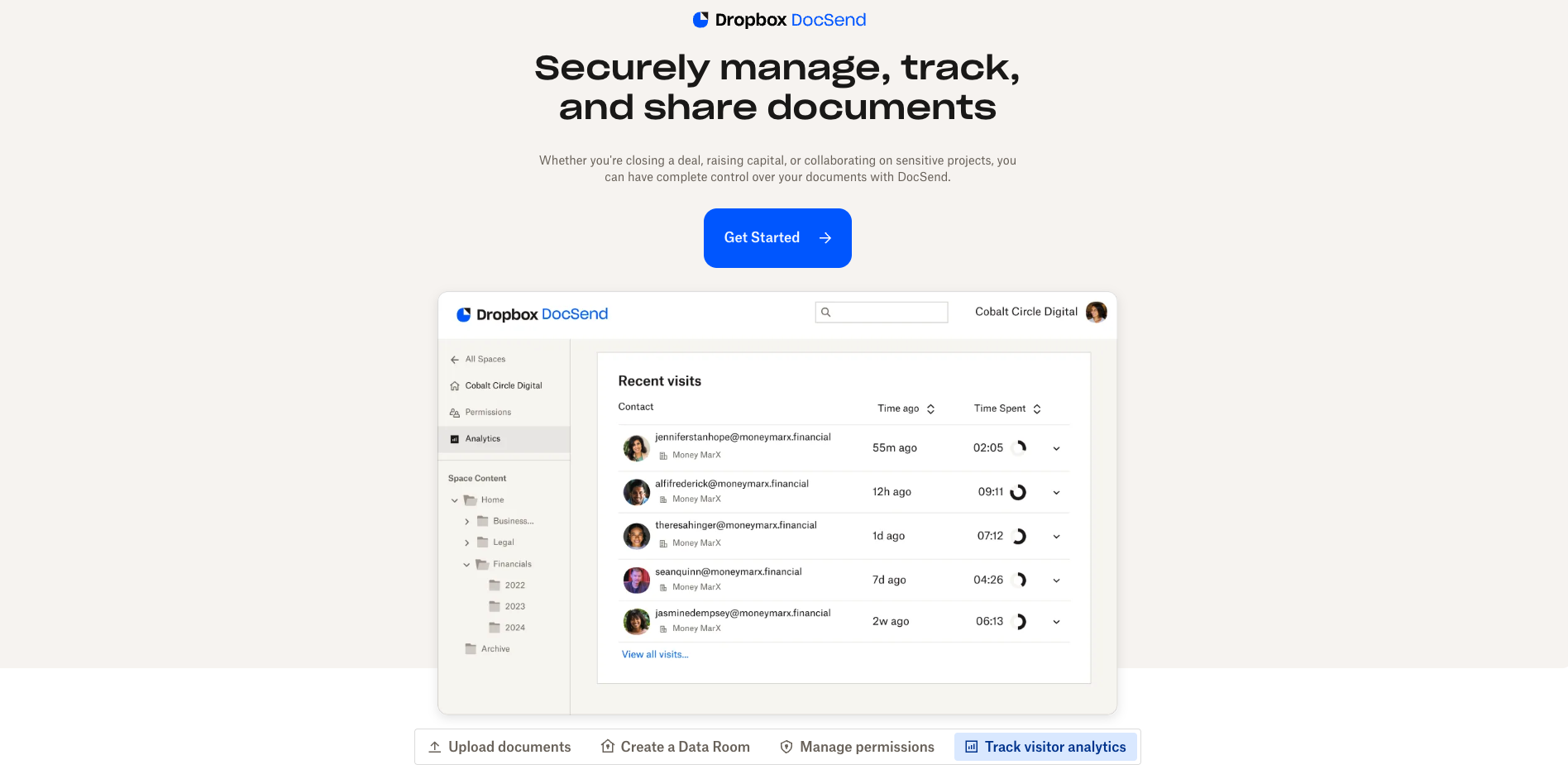
DocSend is a product acquired by Dropbox that allows companies to have complete control over their documents with secure management, tracking, and sharing. Documents can be shared individually, or organized in “Spaces.”
Although DocSend customers have a wide range of use cases including Sales client portals, HR Onboarding and startup fundraising, the team identified an opportunity to expand its market presence by offering a cost-effective Virtual Data Room (VDR), or secure online repository used for storing and sharing sensitive documents and data.
VDRs are commonly used in financial transactions, mergers and acquisitions (M&A), due diligence, legal proceedings, and other business operations requiring confidentiality and secure collaboration.
The team believed Advanced SKU users, representing a significant share of DocSend’s customer base and revenue, were already using DocSend Spaces as VDRs. They believed these users are willing to pay more for a premium plan with more advanced capabilities.
The VDR MVP was soft launched as a reverse free trial A/B test, where 50% of free trial signups during the experiment period:
Received 2 free weeks of the VDR MVP
Had the option to purchase “Advanced Data Room” plan if they chose to upgrade.
To bring the product to general audience, the team needed to answer:
Who is purchasing the “Advanced Data” plan?
What drives their purchasing decision?
Are current “Advanced” plan users actually interested in a VDR solution?
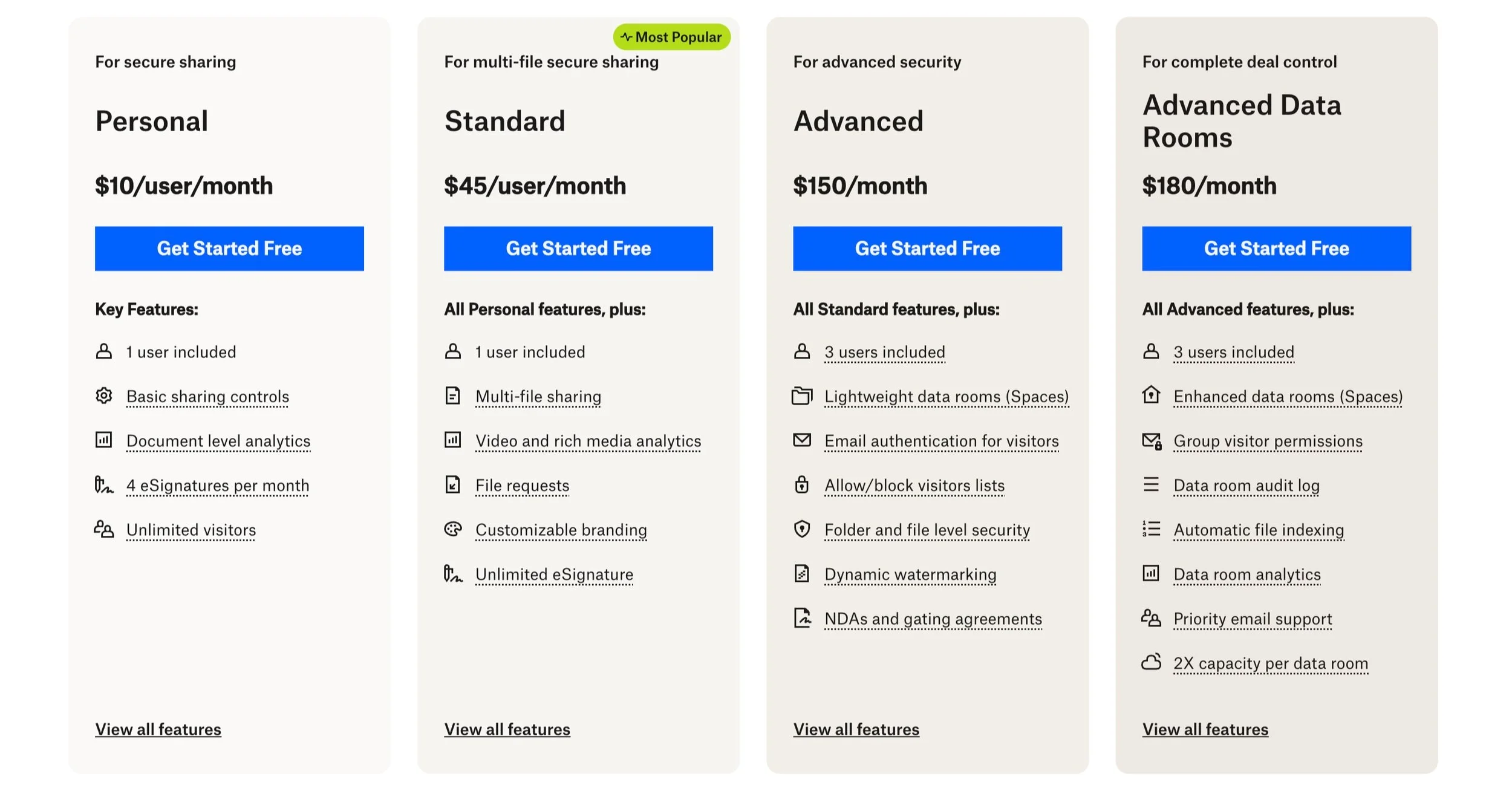
At the time (Q3 2023), DocSend offered 3 paid plans: Personal, Standard, Advanced.
The 4th plan, Advanced Data Rooms, was launched to general public in April 2024.
Objectives
Define the Advanced Data Room customer profile and uncover key motivations for purchasing.
Identify feature gaps and other sensitivities that influence conversion.
Explore trial user behaviors to determine if the VDR solution is resonating target audiences.
Inform product, marketing, and UX strategy to optimize trial conversion.
Timeline + Research Tools
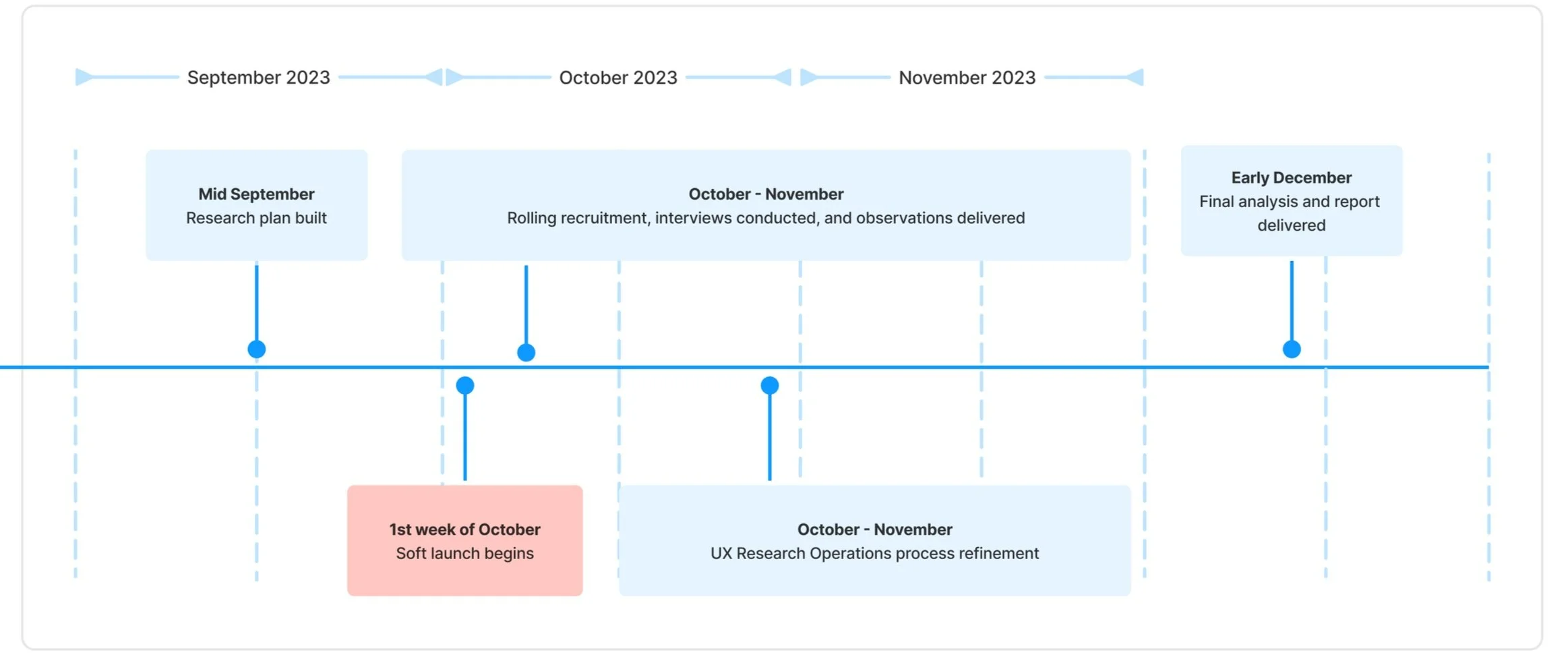
Project timeline and key activities
Who I worked with
Product
Staff Product Manager/Product Area Lead
2 Product Managers owning specific areas of DocSend experience
Design
2-3 area-specific Product Designers: Growth, Spaces, Analytics
Research Operations / Marketing Operations
Recruitment engagement tactics with an out-of-system customer base
Using marketing-owned communication channels for UXR recruitment
Pricing Strategy
Qualitative feedback ONLY
Observers
DocSend Engineering, Product, and Design (EPD)
Research toolkit
Recruitment
Sprig: Attempted to launch the screener survey as an in-app survey, but deprecated due to unforeseen engineering issues.
Databricks, Intercom: Identify variant free trial customers that purchased the Advanced+ SKU
User Interviews: Interview management and incentive provisioning
Data collection, study artifacts, and synthesis
Qualtrics: For survey-based data collection (if respondents weren’t able to commit to a 60 min interview)
Figma: Figjam used for share screen interactive activity,
Miro: Synthesis via affinity mapping
Research
Methodology
Participants:
Target: 15 participants from experiment variant population (5 Advanced Data Room purchasers, 5 Advanced purchasers, 5 non-purchasers)
Actual: 8 participants (4 Advanced Data Room, 4 Advanced) | Non-purchasers were de-prioritized due to technical constraints in identification
Activities:
Moderated interview: background, use case, and decision to purchase
Figjam activity: Understand feature engagement and perceived value to use case
Signal on pricing: what is acceptable?
For Advanced purchasers: Would you be willing to pay for Advanced+? Why or why not?
Limitations
Recruitment for variant trial user interviews will be limited given small population size for Advanced+ purchasers
Projected: ~100 sign-ups by end of experiment period (8 weeks)
Discovering the true value of Adv+ may extend beyond the limitations of a 2 week trial
Key Findings + Deliverables
Define the Advanced Data Room Profile
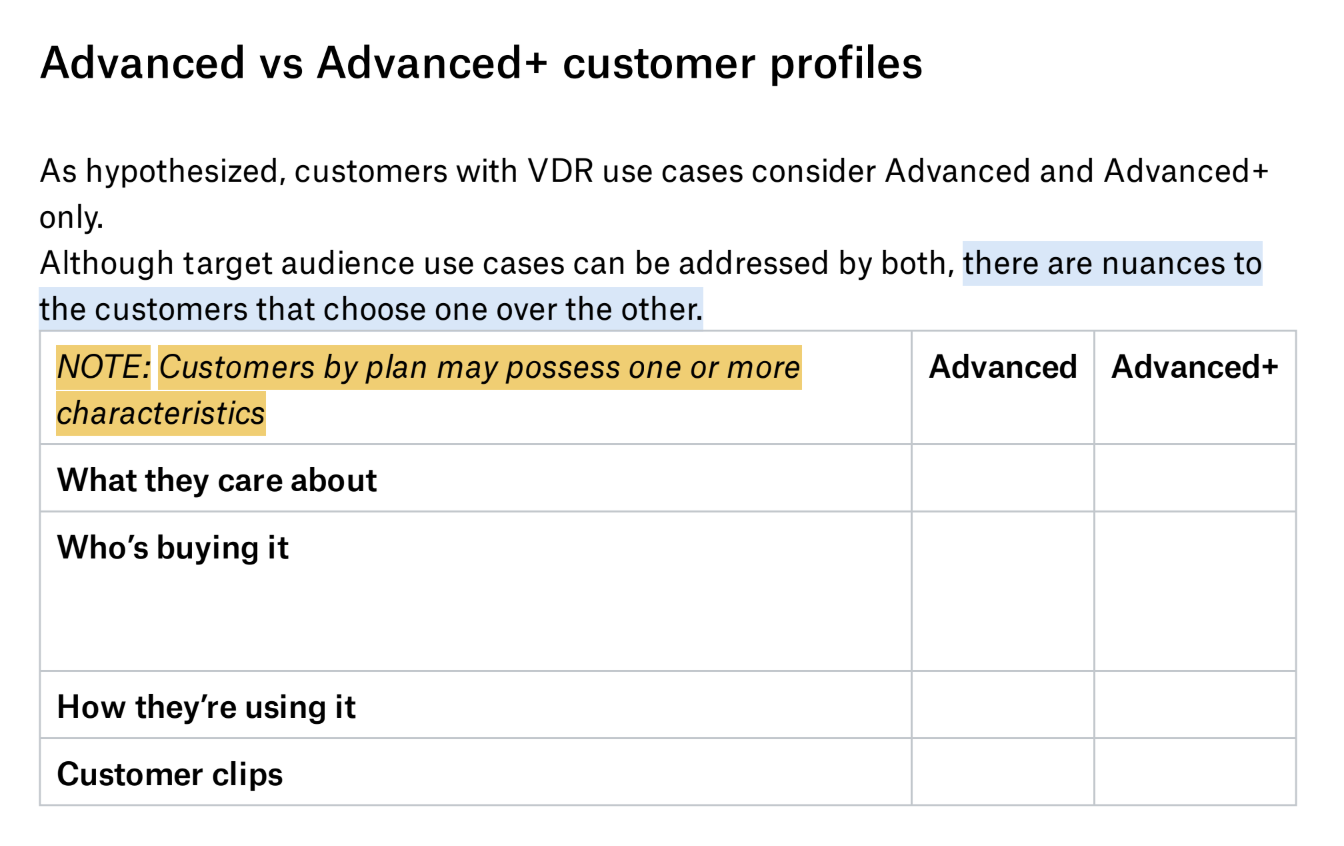
Understanding differences in customer profiles, purchasing motivations, and DocSend feature usage helped the product team prioritize features and supported Product Marketing in creating clearer value propositions.
Left: A redacted view from the final UXR report, detailing key differences between Advanced Data Room and Advanced customers.
Challenges with Plan Differentiation
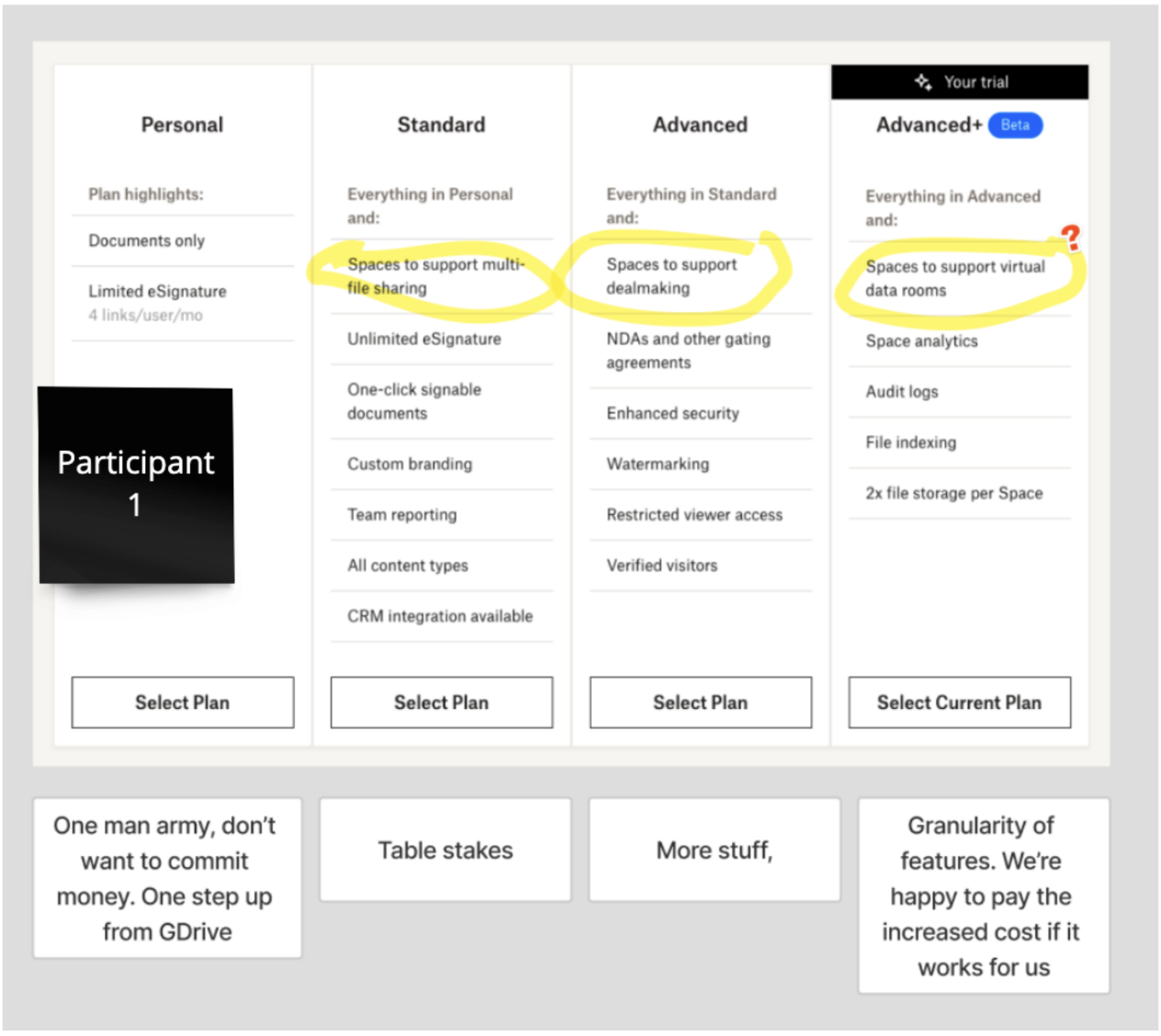
The team wanted to know if customers understood the differences between the Advanced Data Room and Advanced plans, or if they were choosing based on familiarity or “buying the best”.
Insights from this study helped the team clearly communicate complex ideas and highlighted the key information needed to support informed purchasing decisions.
Left: An artifact from the study, where the participant was asked to describe each plan in their own terms. Participants were also asked to identify areas of confusion, and information they felt was missing.
First-ever Customer Testimonials
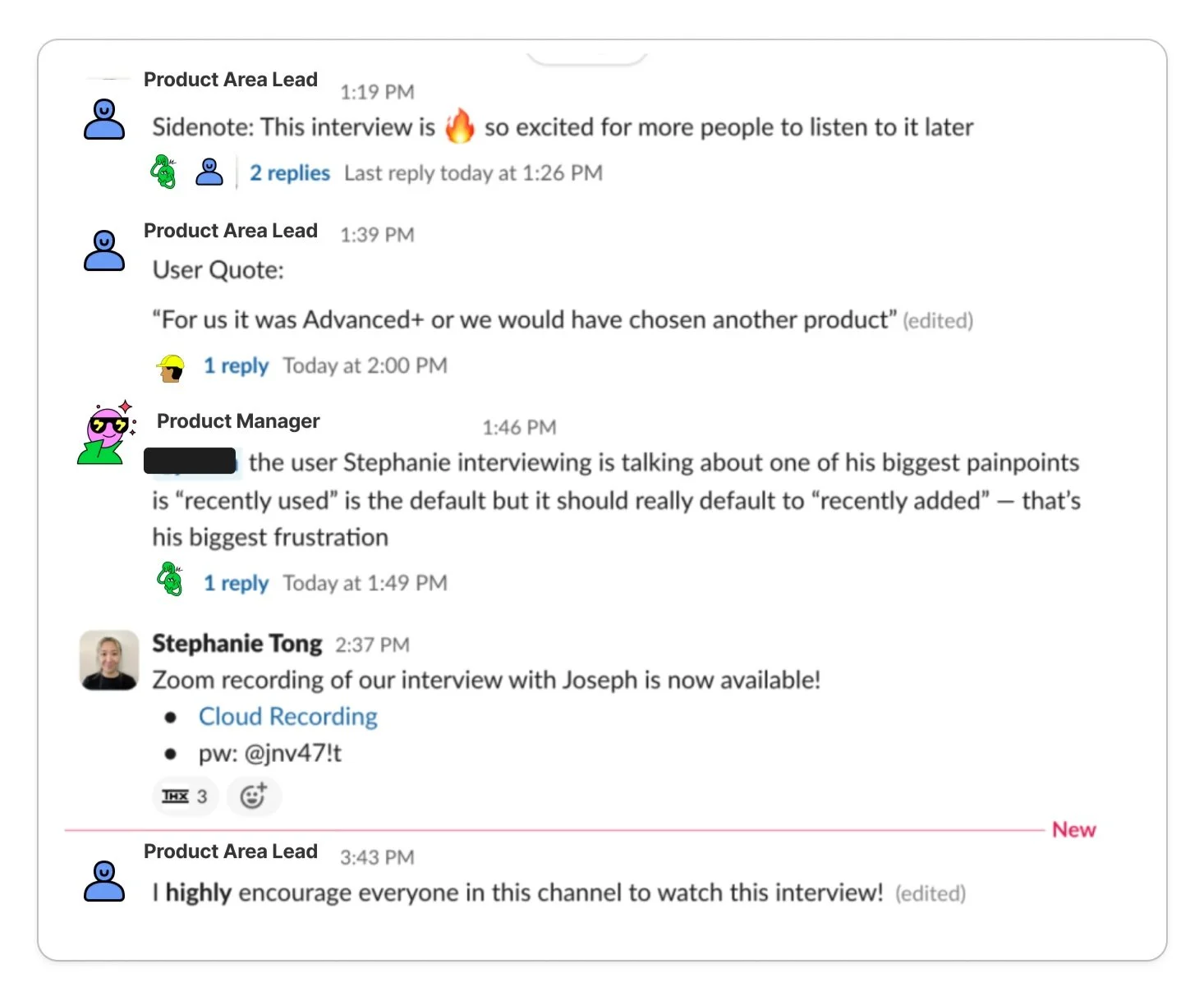
Despite limited resources, especially in data science support, qualitative findings from UX research provided critical context and direction for product success.
The Product Area Lead “felt very thankful” for UX research support, and testimonials and video recordings from customers were prominently featured in team-wide presentations and executive communications.
Left: An anonymized Slack exchange from the study’s Slack project channel.
Business Outcomes
Insights directly informed the decision to move Advanced Data Room from experiment to full launch.
In lieu of data science support, the findings and interview testimonials were the clearest proof the team had that Advanced Data Rooms provided new value to DocSend customers and opened doors to VDR customers who wouldn’t have otherwise considered DocSend.
UX and Marketing refined messaging based on participant feedback.
Customer relationships initiated through UX Research grew into larger partnerships for sales enablement and launch marketing.
Scaling Research for 0-1 Product Builds & Self-Serve Research
Retrospective: Working with small n-count user bases, timing research to match expected conversion timelines, recruitment channels and tactics for low-intent UX research participants.
Reusable DocSend UX research assets: Interview guides, survey templates, exercises.
Reflection
Reflection
What Worked Well
Strong Appetite for User Feedback: The DocSend team actively sought user feedback. Product and Design teams championed UX Research, resulting in high attendance during user interviews. Insights from research were regularly shared in executive updates, team offsites, and planning sessions.
Effective Partnership with Sales Teams: Collaborating closely with Sales and Sales Operations enhanced recruitment efforts by:
Facilitating introductions to account-managed customers interested in UX Research participation
Providing access to sales-owned platforms, enabling researchers to independently identify and recruit qualified customers
Opportunities for Improvement
Improved Operational Coordination: Challenges in recruitment for DocSend revealed a need for stronger collaboration between central Research Operations and individual product teams. This is especially crucial as Dropbox and DocSend currently operate within separate systems.
Earlier Research Integration: Engaging UX Research and Research Operations earlier in the process would ensure that customer feedback and research components are incorporated from the outset, particularly during MVP or experimental phases.
Ex. Customers opt-in to research opportunities at free trial sign-up
Ex. Preemptive setup for tracking dashboards, Eng resourcing for Sprig maintenance
Pushback on method and audience recruitment: Did we need to limit recruitment to only experiment-variant customers? We should be able to deliver the business insights needed by locating comparable audiences elsewhere.
Due to niche audience bases, future DocSend studies heavily relied on vendor recruitment